The True Economics of Growth: Why Cost Visibility Matters
Stronger margins begin with understanding how costs move today—and what those costs make possible tomorrow.
For growing businesses, higher sales do not automatically translate into stronger profits. Material prices change, production requirements evolve and customer expectations increase. When these movements become visible only at the end of the month or quarter, opportunities to protect margins may already have passed.
At A&N, we believe companies need timely visibility into cost movements, combined with a long-term perspective on expenditure. Together, these disciplines help businesses protect current performance while building the capabilities needed for future growth.
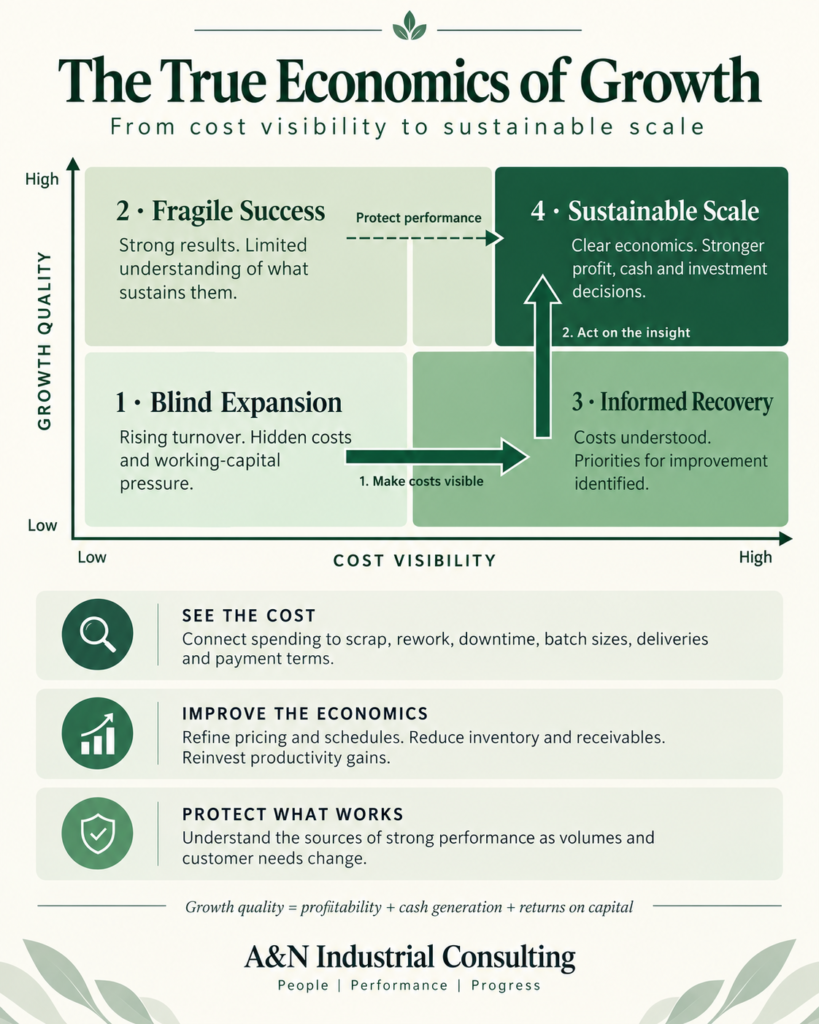
The journey towards sustainable scale: make costs visible, act on the insight and protect the capabilities that support future margins.
Companies should track changes in material consumption, labour productivity, energy use, logistics, quality and working capital as close to real time as practical. Connecting these movements to products, orders and customers helps management understand where expected margins are being lost—and respond through better pricing, purchasing, scheduling and execution.
This visibility should also improve the quality of spending decisions. Essential operating expenditure sustains the business’s ability to deliver. Maintenance, employee capability, quality assurance and reliable systems require consistent attention. Cutting these expenses to improve a short-term result can create higher costs later through breakdowns, rework, delayed deliveries and lost customer confidence.
A&N’s view is that every significant cost should be evaluated over the period in which it creates value.
An expense that puts pressure on today’s margin may strengthen tomorrow’s economics. Training can improve productivity as employees develop proficiency. Preventive maintenance can support equipment reliability and reduce disruption. Better systems can improve planning, inventory control and decision-making. Process improvements can require expenditure before their benefits become visible in output, quality and customer service.
The distinction requires evidence. Spending should have a clear purpose, an accountable owner, an expected benefit and a realistic timeframe. Management must then track whether those benefits are being realised. A long-term perspective gives worthwhile initiatives time to deliver while allowing ineffective spending to be corrected.
For growing companies, this means reviewing current cost movements alongside future operating needs. Leaders need to understand both the reasons for today’s margin pressure and the consequences of the action they take. A reduction that weakens delivery capability may be expensive over time; a carefully managed increase may improve future margins.
The objective is to build a business that uses its resources more productively, delivers reliably and generates the cash needed to sustain expansion.
Track costs in real time. Evaluate their value over the long term. Protect the expenditure that keeps the business running—and hold investment accountable for the stronger margins it is expected to create.
A&N Industrial Consulting
People | Performance | Progress