From Forest Wealth to Consumer Value

A commercial roadmap for Jharkhand’s agroforestry economy
A&N Industrial Consulting | Insight
Jharkhand has the potential to evolve from a consumption market for national brands into an origin hub for branded foods, personal care, industrial ingredients and sustainable packaging. Realising this potential requires an integrated value chain connecting local resources with modern processing, consistent quality and market access.
Forests cover 29.81% of the state’s geographical area, according to the India State of Forest Report 2023. While this establishes the resource context, commercial potential must be assessed through sustainably available volumes, processing economics and buyer demand.
A&N’s perspective: Jharkhand’s next phase of value creation will depend on converting resource advantages into reliable supply chains, differentiated products and scalable enterprises.
1. Design Market Access Around Local Demand
Jharkhand’s demand landscape warrants distinct commercial approaches. Ranchi, Jamshedpur, Dhanbad and Bokaro offer potential markets for differentiated products and premium formats. Emerging centres such as Deoghar, Hazaribagh, Ramgarh, Giridih and Chaibasa can support regional distribution. Rural markets require accessible prices, dependable availability and trusted retail relationships.
These segments should be validated through district-level research. Product, pack size, price and channel choices must reflect purchasing behaviour and replenishment economics.
Strategic implication: Build distribution around kiranas and regional distributors, supplemented by select modern retail, e-commerce and institutional channels. Scale where repeat demand and viable channel margins are demonstrated.
2. Prioritise Value Pools Through Commercial Validation
Jharkhand’s resources offer several potential routes to value addition:
| Resource cluster | Potential opportunity | Requirement for scale |
| Mahua, honey, amla, haritaki and baheda | Selected foods, beverages, personal care and wellness formats | Validated formulations, safety assessment and evidence-based claims |
| Lac, resins, sal seed and forest oils | Industrial and formulation ingredients | Buyer-specific grades, purity testing and consistent supply |
| Bamboo and sal/siali leaves | Tableware, fibre products and packaging | Performance testing, competitive costs and procurement partnerships |
| Tussar silk | Premium textiles, accessories and lifestyle products | Quality consistency, verified provenance and design partnerships |
These opportunities require assessment before investment. Consumer brands demand product development and distribution capability; B2B ingredients require technical specifications and buyer qualification.
Strategic implication: Establish a district-level baseline covering volumes, seasonality, grades, prices, processing yields, losses and sustainable availability. Prioritise opportunities with credible buyers and defensible margins.
3. Pursue a Dual-Track Growth Model
National companies can anchor demand through supplier development, formulation support, procurement commitments and market testing. Their participation can align processing investments with clear product specifications and commercial requirements.
Local enterprises can build regional brands when supported by patient capital, professional management, packaging, quality systems and distribution access. Partnerships should strengthen their capacity to develop products, retain customer relationships and capture greater value locally.
FPOs, self-help groups and Van Dhan clusters can be assessed as aggregation partners, with readiness determined by governance, reliable volumes and delivery performance.
The scale pathway should be staged:
Reliable supply → validated product → repeat purchase → district expansion → Eastern India → selective national and export growth
Expansion should follow demonstrated quality, demand and cash-flow viability.
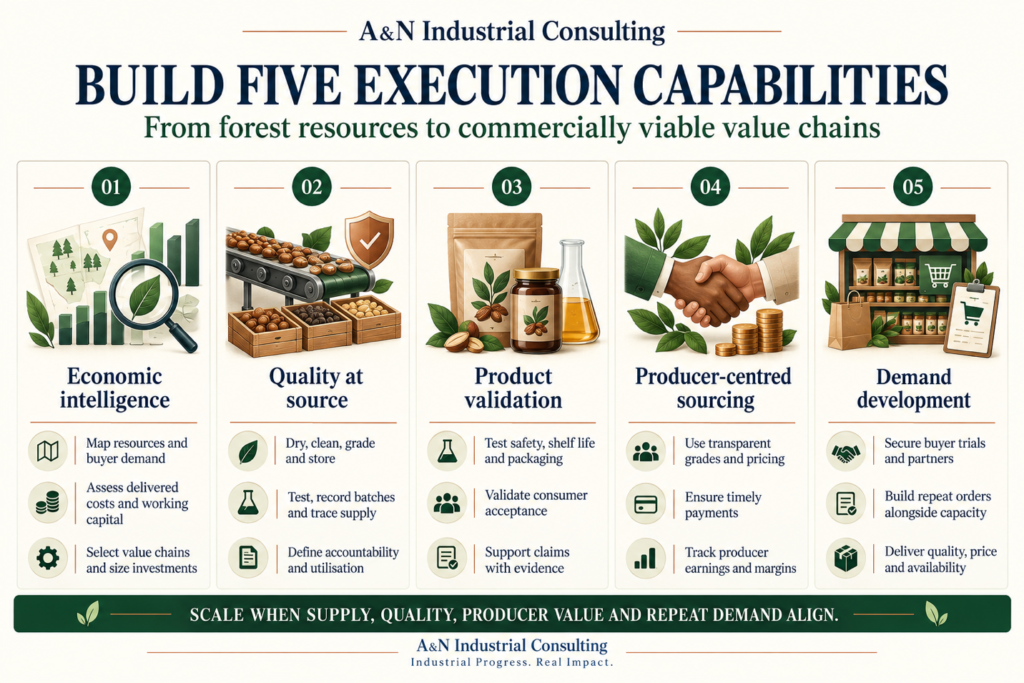
4. Build Five Execution Capabilities
A&N Perspective | Build in Jharkhand, Scale Beyond It
The immediate priority should be a focused portfolio of commercially validated pilots. Select projects with dependable supply, identifiable buyers, manageable processing requirements and credible margins. Measure progress through quality acceptance, repeat orders, producer earnings and cash generation.
National companies can contribute demand and technical capability. Local enterprises can develop brands and retain value. Government and supporting institutions can enable testing, shared infrastructure, skills and market access.
Jharkhand’s opportunity is to move from collection to conversion, from commodities to differentiated products, and from fragmented selling to market-led distribution. An integrated commercial system will determine how much of that value remains within the state.
A&N Industrial Consulting
Industrial Progress. Real Impact.